Can we please give the alphabet linking chart printable the credit it deserves? Because somewhere along the way, this thing became wallpaper. You know what I mean — it gets printed, laminated (maybe), stuck to a wall or tucked into a writing folder, and then… kind of forgotten.
And that breaks my heart a little. Because a good alphabet linking chart is one of the most powerful tools you have for building letter names, letter sounds, and early reading confidence…if you actually use it.
In this post, I’m going to break down what an alphabet linking chart actually is, why it matters so much in early literacy, what to look for when you’re choosing one, and — the fun part — 7 different ways to use it with your students.
P.S. You’ll also be able to grab free printable alphabet charts at the end! These are the perfect tool to add to your writing folders or use in small groups.
What Is an Alphabet Linking Chart?
An alphabet linking chart (sometimes called an ABC chart or alphabet chart) is a reference tool that pairs each letter of the alphabet with a picture whose name begins with — and clearly represents — that letter’s sound. The idea is that students can use the picture as an anchor. When they forget what sound the letter B makes, they look at the chart and see a ball (or a bear, or a bug) and that image links them back to the sound.

The term ‘linking’ is the key word here. The chart isn’t just a display of uppercase and lowercase letters — it’s a memory bridge between the letter symbol and the letter sound. That’s what makes it different from a basic alphabet poster.
Why Alphabet Linking Charts Are Such a Great Tool for Early Readers
Here’s something I want every kindergarten teacher to hear: letter recognition and letter-sound relationships are the foundation of everything. Reading, writing, phonemic awareness, word work — all of it builds on whether students know their letter names and sounds automatically.
An alphabet linking chart gives students an independent resource to fall back on so they’re not constantly raising their hand to ask, ‘What sound does this make?’ It supports:
Letter recognition — students begin to internalize what each letter looks like
Letter sound knowledge — the picture anchors the sound in memory
Letter formation — charts with simple, clear fonts support students in writing center and independent writing tasks
Phonological awareness — students hear and practice the beginning sounds of familiar words
Independence — students learn to use it as a reference tool, which is a life skill
When students have consistent access to a good alphabet chart AND you teach them how to actually use it, it becomes a great resource they reach for on their own. That’s the goal.
Things to Consider When Choosing an Alphabet Linking Chart Printable
Unfortunately, not all alphabet charts are created equal. Before you grab the first free printable alphabet chart you find on Pinterest, here are three things worth thinking through.
1. Look for Familiar, Easy-to-Identify Pictures
The whole point of the picture is to link the letter to the sound, so students need to actually recognize it. A picture of an ‘iris’ for the letter I? Not helpful. Most of your little learners aren’t botanists or avid gardeners. They would think it’s just a flower.
A picture of an ‘igloo’? Much better. But even better— use a real photo your students can immediately connect with.
Real photo alphabet charts are especially powerful for this reason. When students see an actual apple instead of a cartoon one, the connection to the real word is clearer and stronger. It also helps support students who are English language learners or who have limited exposure to some of the more obscure ‘alphabet book’ vocabulary.
👉 Want a real photo alphabet chart? Download a Free Alphabet Chart with Real Photos
2. Check the Sounds — Especially for Tricky Letters
This one is big. Are the pictures on the chart a true representation of the letter sound? This matters more than you might think.
Watch out for blends. A picture of a ‘clock’ for the letter C, for example, is tricky — students might hear the /kl/ blend instead of a clean /k/ sound. The cleaner and more isolated the beginning sound, the better.
The letter X deserves special attention. Words that begin with X (like xylophone or x-ray) don’t actually represent the /ks/ sound — they make a /z/ sound or a different sound entirely. Look for an alphabet chart that uses a word where X appears at the end, like fox or box, so the /ks/ sound is clear. This is a small detail that makes a big difference for your beginning readers.
Consider each vowel sound. Your alphabet linking chart should include at least the short vowel sound as that is what students will need as they begin decoding, if not both the short sound and long sound. Some alphabet charts include a mix of both short and long vowels which is confusing for our students.
You’ll also want to think about what word is representing each vowel sound. For example, “owl” may seem like the perfect choice for the short o vowel sound, but it actually begins with the diphthong sound /ow/!
3. Think About the Font
Simple fonts matter. Look for a chart that uses clean, easy-to-read letterforms — especially for lowercase letters. If the lowercase ‘a’ on the chart looks like a fancy two-story ‘a’ that students will never actually write, it creates confusion.
The chart should reflect what students will encounter when they’re reading and what they’ll be expected to produce when they’re writing. Simple is always better here.
7 Ways to Use an Alphabet Linking Chart in Your Classroom
Okay, here’s the part I actually love. Because there are SO many different ways to use an abc chart beyond just hanging it on the wall. Let me walk you through seven of my favorites — some for whole group, some for small groups, and some for independent work.
1. Whole Group: Build a Daily Alphabet Routine
One of the most effective things you can do with an alphabet linking chart is make it part of a predictable daily routine. A consistent alphabet routine during whole group time gives students repeated, low-stakes exposure to letter names and letter sounds every single day — and that repetition is exactly what builds automaticity.
We started our morning every day by completing our alphabet chart routine during our morning meeting time!
It was such a simple part of our daily routine that I didn’t even realize what a powerful activity it was until I saw students running through the routine while at their learning center to help them identify letters they were working with.
I’ve got an easy alphabet routine outlined for you right here in this post — it’s a great tool for the whole class and works just as well for small groups too.
2. Whole Group Review Game: Sticky Note Mystery Letters
This is one of those letter recognition activities that’s oh so simple but students absolutely love it. Before whole group time, cover up a few letters on your alphabet chart with sticky notes. Ask students to look at the chart and guess which letters are hiding based on the pictures and context clues around them.
Bonus idea for later in the year: Once your students have solid letter recognition, take those sticky-note-covered letters and tell them you’re going to unscramble them to spell a mystery word. Students use their letter knowledge to figure out what word is hiding. It’s a fun twist that stretches into simple words and early phonemic awareness work — all from one great tool.
3. Small Groups: Warm-Up with the Same Alphabet Routine
Your small group time is precious, and using the alphabet chart as a warm-up to your small group routine is a perfect way to ease students into the session. Run through the same alphabet routine you use in whole group — it’s familiar, it’s fast, and it primes their brains for the letter work that’s coming.
Consistency between whole group and small groups is a great resource for building confidence, especially in your students who need more repetition.
4. Small Groups: Review Games That Build Letter-Sound Relationships
Once students know the routine, you can shake things up with these small group game variations (especially with your pre-reader small groups. All you need is the chart and a few simple materials.
- Call and point: Call out a letter name or letter sound and have students point to it on the chart — or cover it with a fun counter or mini eraser. Great for letter recognition and letter-sound practice.
- Race to Read: Grab a sand timer and challenge students to read through the entire alphabet chart before time runs out. They will be SO motivated by this. Add some friendly competition between turns and watch the engagement go through the roof.
- Mystery Letter: Say ‘I’m thinking of a letter that…’ and give clues. Early in the year, keep it simple: ‘I’m thinking of a letter that makes the /m/ sound.’ Later in the year, layer in more: ‘I’m thinking of a letter that comes after D and makes the /e/ sound.’ This works across a huge range of levels.
- Eyes closed, yell it out: Point to a letter on the chart and tell students to close their eyes. When you say ‘open,’ they look at where you’re pointing and yell out the letter as fast as they can. Students think this is hilarious. You will too.
5. Writing Reference: A Tool Students Actually Use
This is where the alphabet linking chart earns its keep every single day. Teach students explicitly (and early) that when they’re writing and they’re not sure what letter to use for a sound, they look at the chart. Model this over and over in whole group writing. Make it a habit.
When students internalize this, you’ll see them pausing mid-word, scanning the chart, finding their letter, and getting back to writing independently. That’s the goal. A chart in every writing folder or at every writing center table makes this a natural part of independent work.
6. Literacy Center: Magnetic Letter Matching
Here’s a hands-on activity that combines letter recognition with tactile learning — perfect for a magnet literacy center. Print your alphabet chart at poster size and attach it to a large metal cookie sheet or oil drip pan. You can find these at the hardware store for just a few dollars.
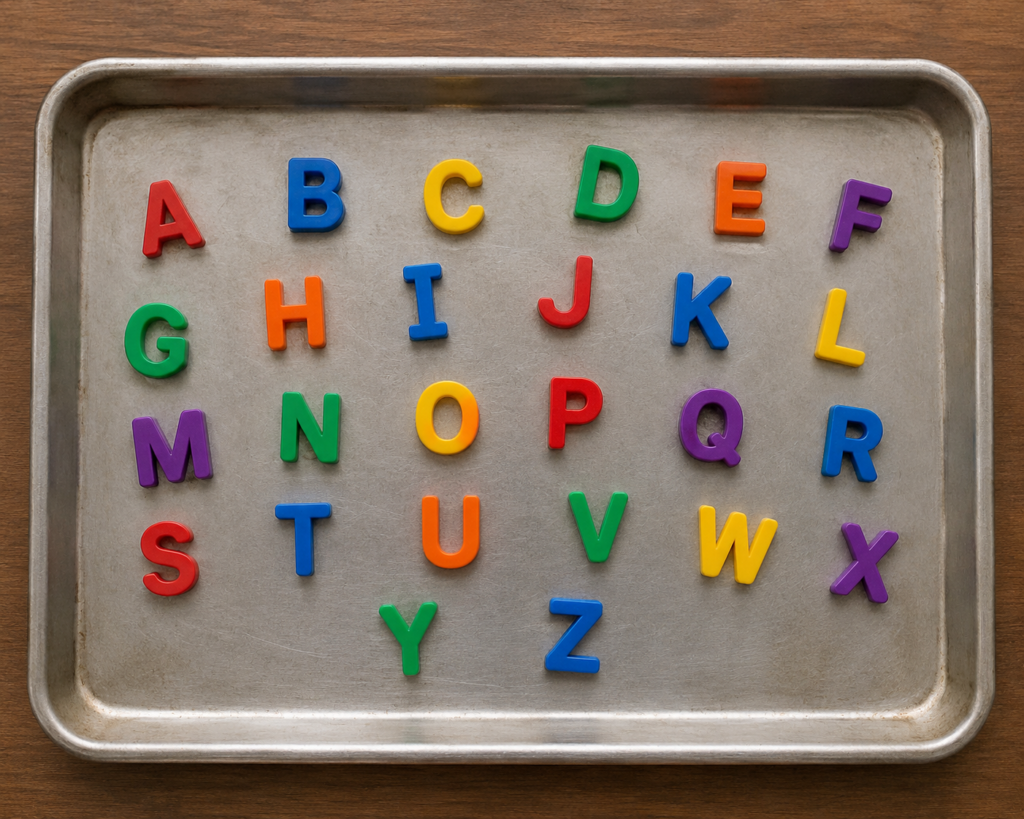
Set out a bin of magnetic letters and let students match the magnetic letters to the corresponding letters on the chart. This is great for uppercase and lowercase letter recognition, and students can work on it independently once they’ve been shown the routine. It’s a simple setup with a big payoff.
7. Alphabet Chart Puzzles
Have you ever seen 100 chart puzzles where students cut the chart into strips or chunks and reassemble it? Same concept — just with the alphabet chart. Cut the chart into strips or irregular chunks and have students put it back together.
To be honest, knowing ABC order isn’t actually the most critical early literacy skill. But these puzzles are a great way to help students become familiar with the overall layout of the alphabet chart so they can find letters quickly and independently. It’s also a perfect early finisher activity or morning work option.
Grab Your Free Alphabet Linking Chart Printable
Ready to put these ideas to work? I’ve got you covered with a free real photo alphabet chart — perfect for whole group display, writing folders, small groups, and all seven of the activities above.

👉 Click here to grab your FREE Real Photo Alphabet Chart + Nametags

Do you love free stuff?
Real Photo Alphabet Charts and Nametags
This set includes a variety of real photo and clip art alphabet charts to use in your small groups or around the classroom. It also includes editable student nametags in a variety of colors.
(If you want to connect your alphabet linking chart with the rest of your classroom decor, the letter sound photos used match up with these alphabet posters, word wall headers, and my free sound wall!)
And if you want even more chart options — including different styles that work well for small groups and word work — check out this post on setting up your Science of Reading small groups. There are even more free resources waiting for you over there.