Kindergarten is a time for so many amazing things! New friends, new experiences, learning how to be part of a classroom, and figuring out how to navigate a much bigger world. And, of course, all of the emotions that come along with it!
With so many new things happening at once, it’s no wonder our young learners sometimes need a little extra help managing their feelings.
Kindergarteners are still learning what their emotions feel like, how to name them, and what they can do when those feelings become overwhelming. We all know it can be a lot!
That’s why a calm down corner in kindergarten can be such a valuable tool for helping young learners navigate those big feelings.
Today, I’m sharing how to create a calm down corner in kindergarten that actually works, along with some of my favorite tips for teaching students how to use it effectively.
In this blog post, I’m also sharing my complete Calm Down Corner Kit, which is a great, low-prep way to get your space up and running! If you’re ready to add a calm down corner to your classroom, without having to create visuals and resources yourself. this is a great place to start!
What Exactly is a Calm Down Corner?
A calm down corner like many things, can be done many different ways. But the basic premise is that it is a designated space where children can go when they need some quiet time to work through their emotions and regain a sense of calm.
The purpose isn’t to isolate students or punish them for having big feelings. Instead, a calm down corner provides a safe, quiet space where students can practice strategies that help them regulate their emotions and return to the class when they’re ready.
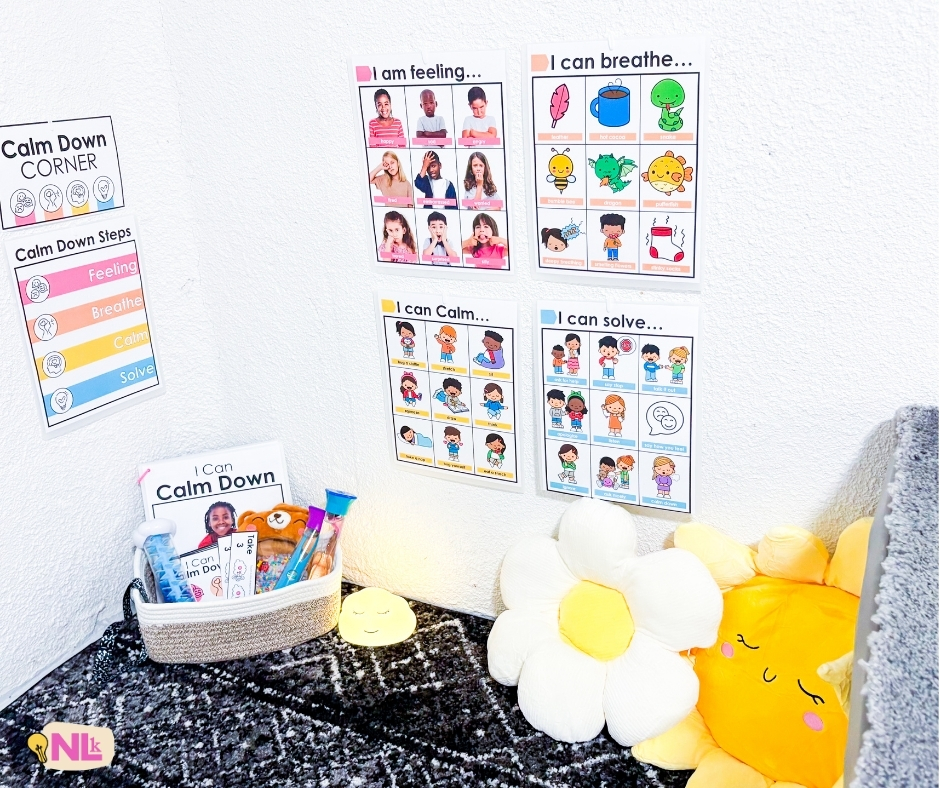
A calm down corner doesn’t need to be fancy or take up a lot of space. What matters most is that students understand what the space is for.
Taking the time to prepare the space and explicitly teach students how to use it effectively is just as important as the space itself. If done correctly, a calm down corner can become an incredibly useful tool in your Kindergarten classroom.
Why Every Kindergarten Classroom Needs a Calm Down Corner
Think about all of the tools we use as adults to help regulate our emotions throughout the day.
Maybe it’s taking a few deep breaths in the car before heading inside, closing our eyes for a moment, enjoying a quiet cup of coffee, going for a run, or doing some yoga. And sometimes, let’s be honest, maybe it’s screaming into a pillow.
Even with all of those strategies available to us, managing our emotions can still be difficult sometimes. I honestly feel like I’m often hanging by a thread; I’m sure many of you teachers and parents can relate!
So it makes sense that our Kindergarten students need opportunities to learn and practice these skills, too.
Kindergarten is full of new experiences, transitions, social situations, and big emotions. A calm down corner in kindergarten gives students a designated place where they can pause, practice using a strategy, and begin working through those feelings.
I loved having a calm down corner in my classroom, it was always an extremely well-used space. The key is remembering that the corner isn’t intended to be a permanent destination. It’s a tool students can use when they need it. The ultimate goal is to use the corner, and then have students return to their learning in a timely manner.
If you are thinking this sounds like something you want to add to your classroom, I would love for you to have a look at my Calm Down Corner bundle! This resource includes absolutely everything you need to create your corner, everything is ready to print and use. And if you don’t have space for a full calm down corner, I include portable and individual options in the bundle as well.
Simple Steps to Set Up Your Own Calm Down Corner
Here are some of my favorite tips for setting up your calm down corner:
Step 1: Choose the Right Location
Where you put your calm down corner matters. You’ll want to choose an area that feels somewhat removed from the regular classroom environment so students have an opportunity to step away from the noise and activity.
At the same time, you don’t want the space to feel completely isolated or hidden away. You should still be able to supervise students and make sure they’re safe. And remember, your calm down corner doesn’t need to be huge! A small cozy space is usually best.
In my classroom, this was simply a corner of the room that I could easily see at all times (important), but that felt private because it was next to our A/C unit and a bookshelf.
Seating was simple too! I just used a storage tub with a fuzzy bathmat on top of it. Comfortable but not too comfortable, super easy to throw in the wash and clean, and doubled as storage for my extra books.
Remember, the goal isn’t for students to spend a large portion of their day there. It’s simply a place where they can pause, use their strategies, and return to the classroom when they’re ready.
Step 2: Add Visual Supports
A calm down corner is only as useful as the tools students have available to them.
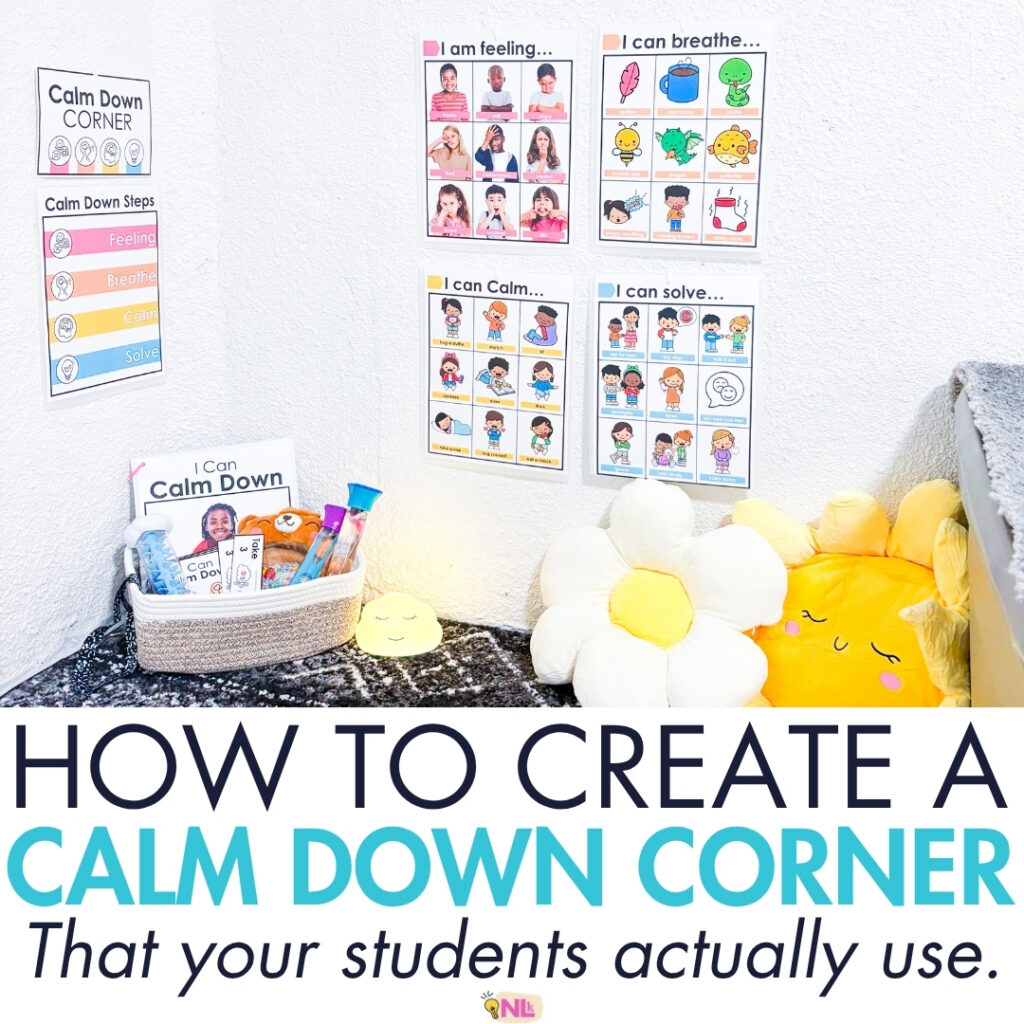
The point of a calm down corner is that it is more than just a quiet space. It’s important to give students visual cues that remind them what they can actually do when they’re there.
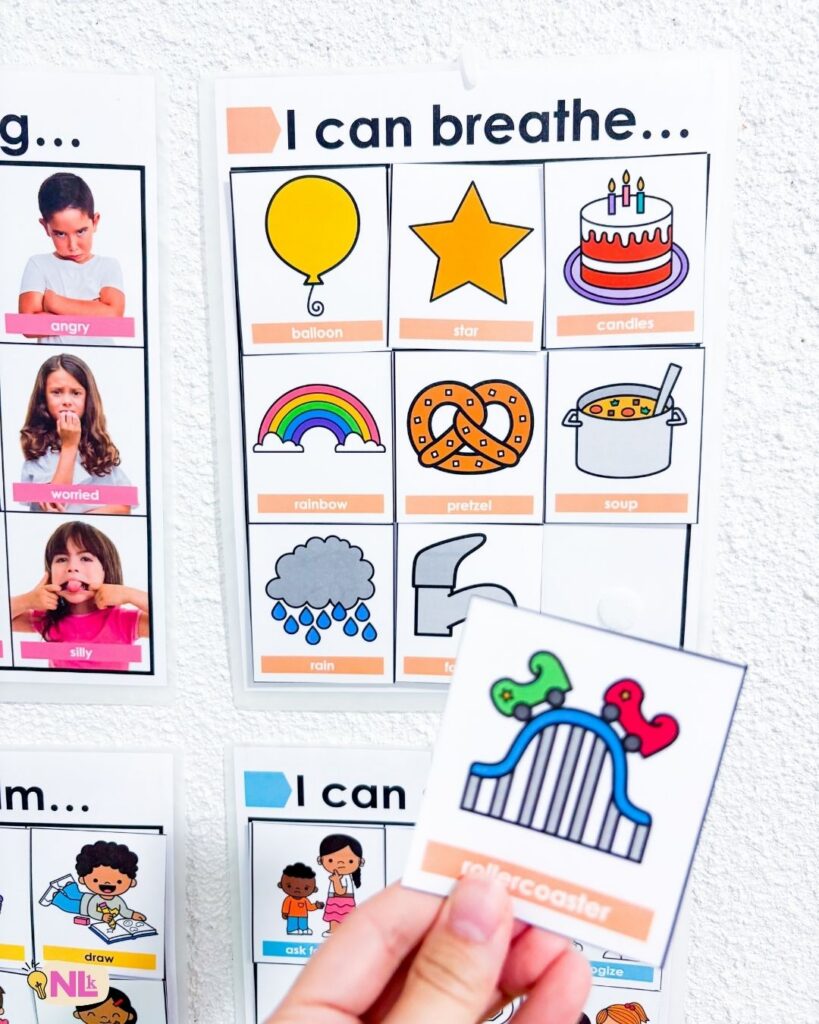
Especially for Kindergarten students, visual supports can make abstract concepts like emotional regulation much easier to understand. Your visuals might include calm down steps, breathing exercises, calming strategies, emotion visuals, or reminders about how to use the space.
I created my Calm Down Corner Kit with this in mind. It includes a variety of ready-to-print visual supports so you can create a helpful, cohesive space without having to design everything yourself.
There are pre-made posters, or you can add your own choices using Velcro dots (great if you want to introduce new breathing exercises or calm down choices throughout the year).
Click here to explore the Calm Down Corner Kit on Teachers Pay Teachers.
Step 3: Teach Students Deep Breathing Exercises
One of the most useful tools you can teach students is something they always have with them: their breath!
But don’t assume that students automatically know how to take a deep breath to calm themselves down. This is something that needs to be explicitly taught and practiced.
Before opening your calm down corner, at the start of the year I would suggest spending some time teaching your students a variety of breathing exercises. Practice them when everyone is calm.
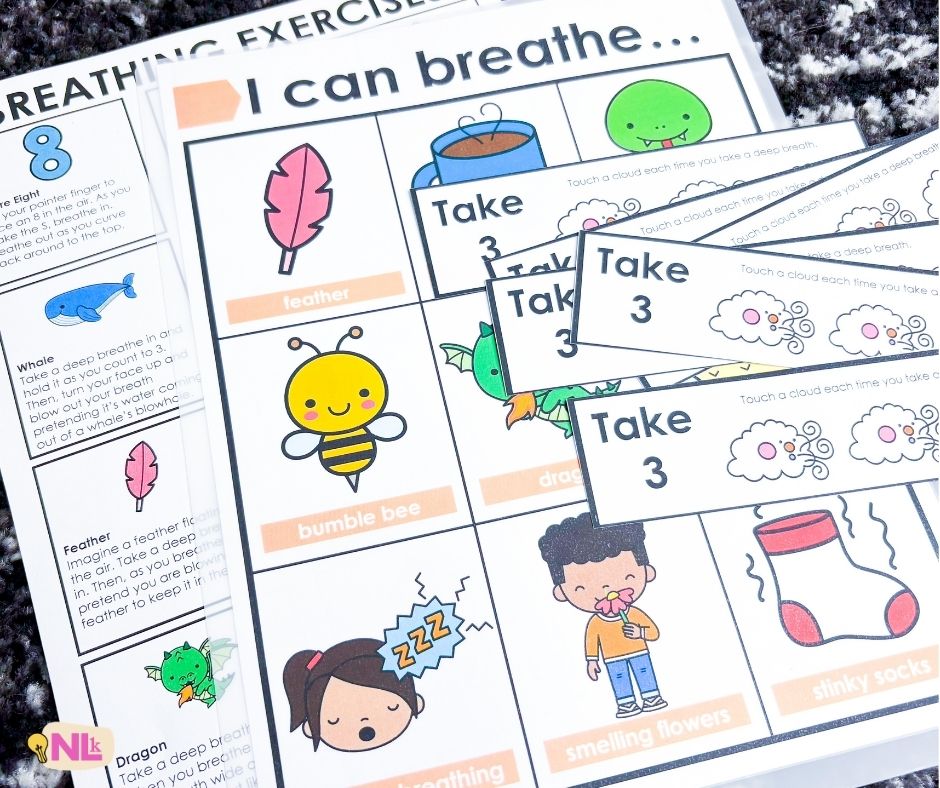
You can make it fun by pretending to smell a flower and blow out a candle, slowly breathing in and out together, or using a visual breathing prompt.
When students have practiced these strategies ahead of time, they’re much more likely to remember them when they actually need them.
Step 4: Teach Students Calming Strategies
Deep breathing is just one strategy students can use. Take time to introduce your students to several other ways they can calm their bodies and manage their emotions.
You might teach students to take deep breaths, count slowly, stretch, sit quietly, use a sensory tool, talk about how they’re feeling, or take a short break from a situation.
The important thing is to teach these strategies before students are in the middle of a big emotional moment.
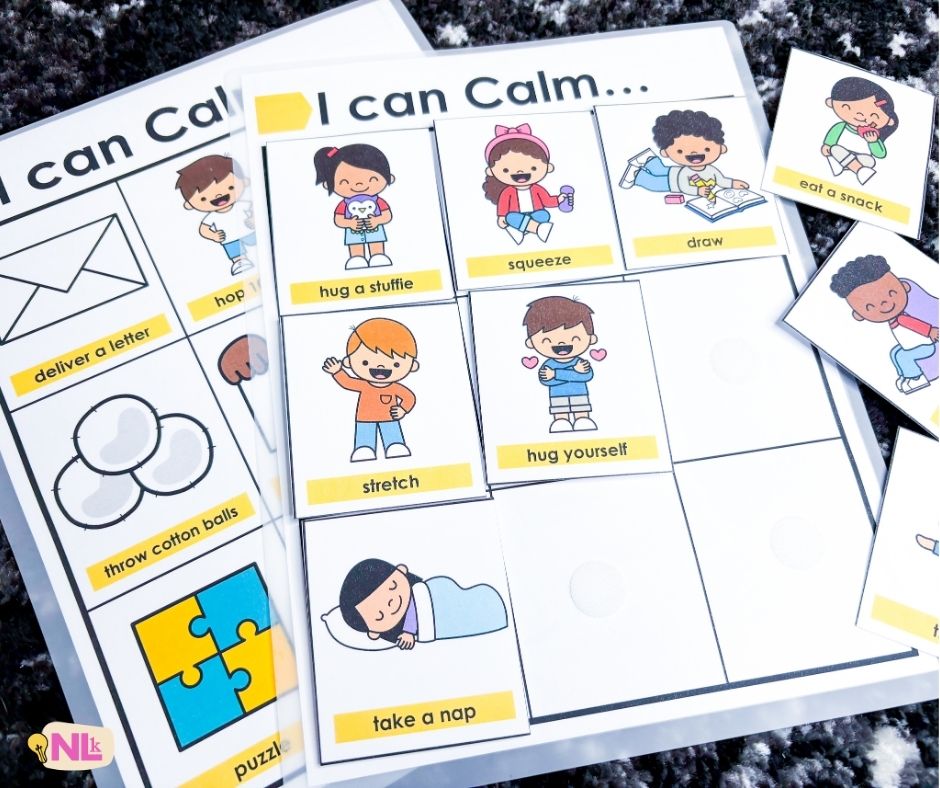
Your visual supports should also serve as reminders of strategies you’ve already practiced together! The goal isn’t for every child to use the exact same strategy. The idea is to teach them a variety of options so that students can discover which tools work best for them.
Step 5: Include Simple Calm Down Tools
Remember, the key to a successful calm down corner is to keep it simple. You don’t need to fill the space with dozens of toys, activities, or sensory tools (in fact I highly suggest not doing this.)
You can add your calm down steps to the wall along with a small basket containing a few sensory or calming options.
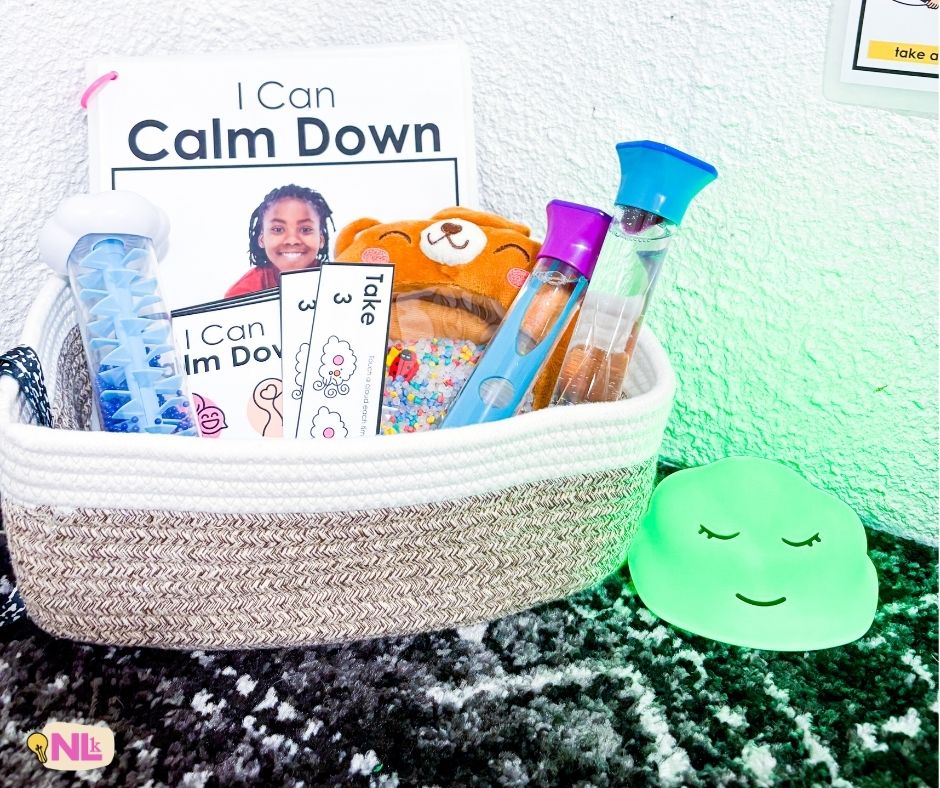
The exact tools you choose will depend on your students and classroom, but a few thoughtful options are much more useful than an overflowing collection of items.
Step 6: Teach Expectations (The Most Important Step)
This might be the most important step of all.
A calm down corner will only work if students understand exactly how and when to use it. Just putting a cozy space in the corner of your classroom and telling students they can use it isn’t enough.
Before you open the space, explicitly teach your expectations. You might establish rules such as having only one student use the space at a time, using the tools appropriately, keeping the space quiet, and tidying up when you’re finished.
You should also explain what the calm down corner is not. It is not a place to play, avoid work, or escape classroom expectations.
Practice using the space with your class. Model what it looks like to recognize that you’re becoming upset, choose to use the calm down corner, select a strategy, calm your body, and return to the classroom. The more clearly you teach the expectations at the beginning, the easier it will be for students to use the space successfully throughout the year.
Step 7: Practice All Year Long
Once you’ve opened your calm down corner and taught students how to use it, don’t forget about it!
It’s easy to spend a lot of time teaching classroom routines at the beginning of the year and then assume students will remember everything forever. Kindergarteners really benefit from regular reminders and practice.
It is also important to continue talking about emotions, modeling calming strategies, and reminding students how to use the space appropriately throughout the year. I often will teach or review a new breathing technique or calm down strategy each week. This way they are constantly learning new techniques, and considering what works best for them and their bodies. I also highly suggest revisiting the expectations after a long break or anytime you notice students need a refresher. The more consistently students practice these skills, the more confident they’ll become in using them independently!
Common Mistakes to Avoid
Setting up a calm down corner in kindergarten can be incredibly helpful, but there are a few common mistakes you’ll want to avoid.
- Making it a punishment. A calm down corner should never be used as a place where students are sent because they’re “bad.” The purpose is to teach students how to recognize and manage their emotions.
- Filling it with too many toys. In my experience, more toys in a calm down corner are not better. Too many items and it can turn the space into a play area or make it difficult for students to focus on actually calming down.
- Using only one calming strategy. Every child is different, and what works for one student may not work for another. Giving students several strategies to try and help them discover which ones are most effective for them.
- Expecting immediate independence. Keep in mind that your kindergarteners are learning these skills for the first time! Expecting students to immediately recognize their emotions, choose an appropriate strategy, and independently regulate themselves isn’t realistic. But with modelling, practice, and support your students will gradually become more independent over time.
FAQ
How long should students stay in the calm down corner?
There’s no magic number of minutes that will work for every child. The purpose is to give students enough time to use a calming strategy and regain control of their emotions, not to have them sit there for an extended period of time. Don’t think about the calm down corner as a timed activity. Instead, focus on helping students recognize when they are ready to return to the classroom.
If you do find certain students are staying longer than necessary (I find there’s always a couple!) As I mention below, there may also be an underlying reason why certain students are spending more time here. This being said, you may find some students just need a bit longer in the space than others, and some will also rely on the calm down corner more than their peers.
Do students need to ask permission?
This is something you’ll need to decide based on your classroom and students. Some teachers allow students to independently access the space, while others prefer students to ask or use a visual signal. For Kindergarten, I think it can be helpful to begin with more teacher guidance and gradually give students more independence as they demonstrate that they understand how to use the space appropriately.
What if students are over-using the calm down corner?
If a student is spending a lot of time in the calm down corner, it may be a sign that they need additional support with emotional regulation or that something else is going on.
Start by observing when and why they’re using it. Are there particular transitions, activities, or social situations that seem to trigger the need for a break?
You may need to provide additional instruction, practice strategies more frequently, or offer support outside of the calm down corner. Remember, the goal isn’t to prevent students from using the space. It’s to help them learn skills they can eventually use throughout the classroom and beyond.
You can also set a timer at the calm down corner, but I suggest this as a last option.
Note: You will probably notice students wanting to use the calm down corner all. the. time when you first open it. This is completely normal as it is new and novel! You may be tempted to limit who can go and when, but I suggest just waiting it out. The newness will wear off quickly!
What if students misuse the space?
If students are treating the calm down corner like a play area, revisit your expectations. You may need to model appropriate use again and practice together as a class. If this is happening, it may also be worth considering whether the space has too many distracting items. Sometimes simplifying the corner can make it much easier for students to use it for it’s intended purpose.
What grade will this work in?
Although this post focuses on creating a calm down corner in kindergarten, the basic concept can work across many age groups. The key is adapting the language, visuals, strategies, and expectations to the developmental level of your students. You can easily adjust the space for preschool, primary grades, or even older students who would benefit from having a designated place to pause and regulate their emotions.
What if I have limited space in my classroom?
Honestly, you don’t need a full calm down corner at all! You can make a calm down bag that is easy to take around the room or around the school. My calm down corner kit also comes with a portable calm down kit option that you can attach to a lanyard.
Classroom Calm Down Corner Kit
I know what you’re thinking… A calm down corner is such an amazing resource to have in a Kindergarten classroom! But if the thought of prepping and putting it all together is what’s holding you back, I’ve got you covered. I have created a complete Calm Down Corner Kit that’s ready to use—you just print, prep, and set up your space!
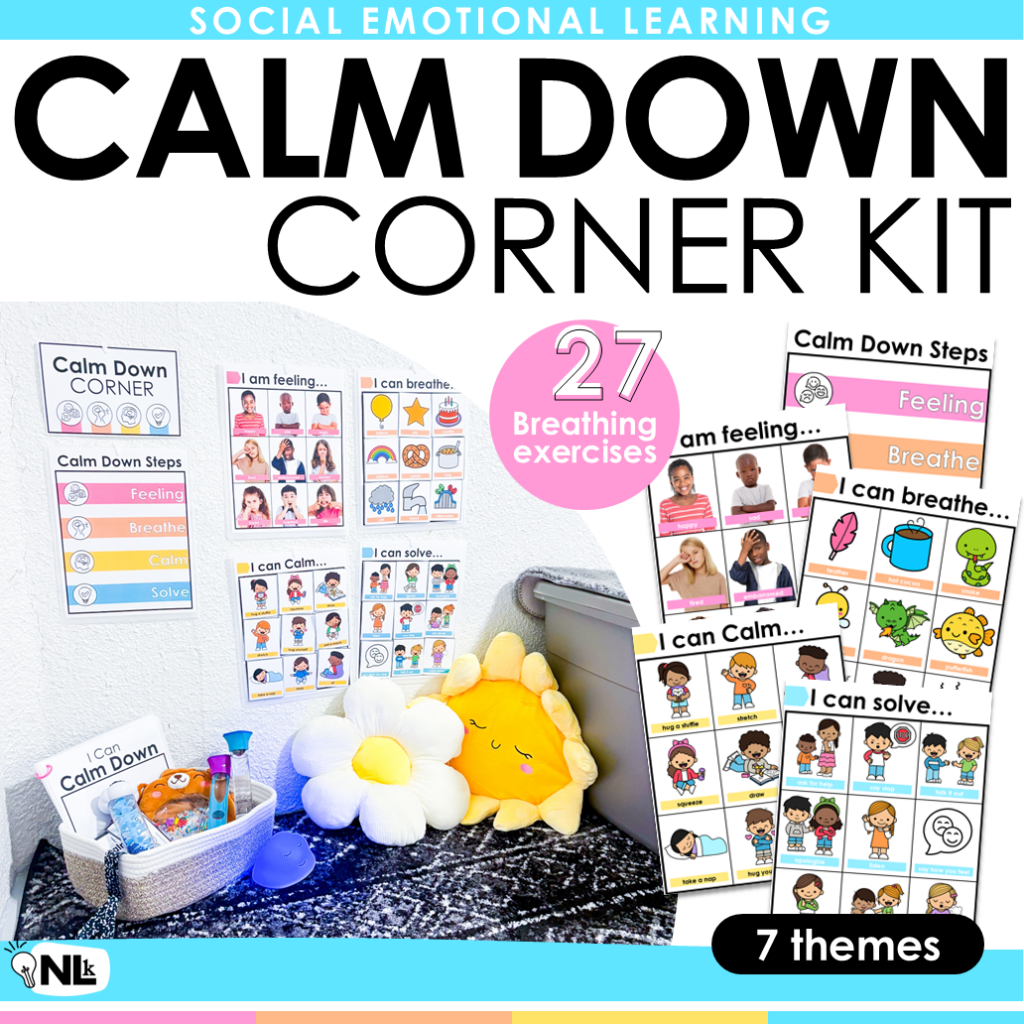
This digital download includes everything you need to get your Calm Down Corner up and running, including teacher instructions, 27 breathing exercises, calm down choices, and problem-solving strategies. Everything is designed to help you teach these important skills while gradually building independence in your Kindergarten students.
I’ve also included options for a mobile or personal calm down kit that students can keep at their own tables. This makes it easy to bring calming strategies into your classroom even if you don’t have space for a dedicated corner.
One of my favorite parts of this package is that you also have 7 different color themes to choose from, so you can easily coordinate your Calm Down Corner with your existing classroom decor. Choose from Brights, Pastels, Boho, Primary, Forest, Blues, or Simple. Not only is this Classroom Calm Down Corner Kit comprehensive, but it’s also a great value for everything included in the package!
Click here to take a closer look at the Calm Down Corner Kit
Creating a Calm Space for Big Feelings
There is no doubt that Kindergarteners have BIG feelings. And learning how to manage those feelings is a skill that takes time, practice, and lots of patience. A calm down corner of course isn’t going to magically make every emotional moment disappear. Instead, it’s a tool we can give our students. Having a calm down corner in kindergarten is a great way to teach your kiddos how to understand their emotions, calm their bodies, solve problems, and eventually become more independent in managing big feelings.
And remember, your calm down corner doesn’t have to be complicated. A small, cozy space, a few intentional tools, clear expectations, and consistent teaching will go a long way.
If you’re ready to create a calm down corner in kindergarten but don’t want to spend hours designing all of the visuals and resources yourself, my Calm Down Corner Kit gives you the print-ready materials you need to get started! It’s a simple way to create a supportive space that feels intentional, inviting, and ready for your students to use.