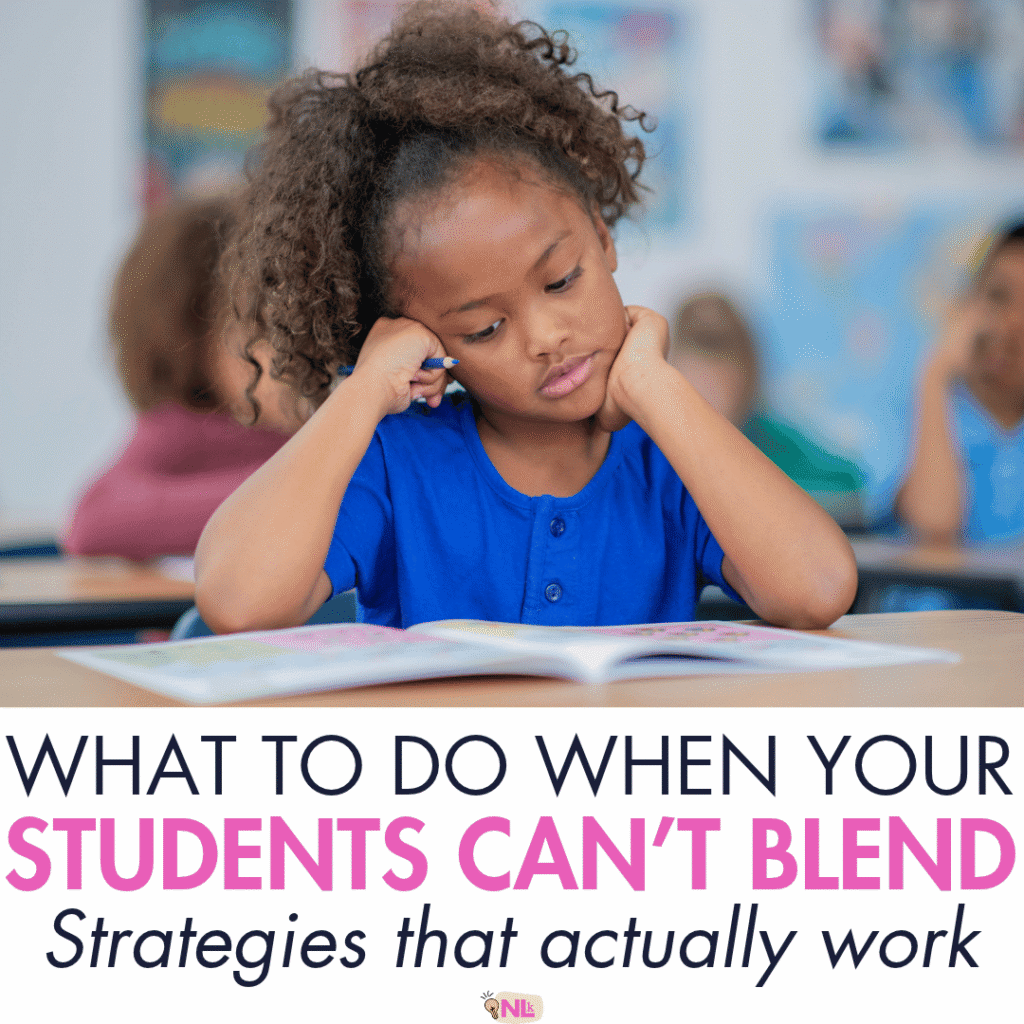
In this blog post: Are you wondering why your Kindergarten students can’t blend words? We’ll identify why your child struggles, how to build the phonemic awareness skills needed to blend words, and what not to do when working on blending.
If you teach Kindergarten, this situation probably sounds familiar: You ask a child to read simple CVC words. They know the letter sounds, so this should be a breeze, right?
You show a child the word mat. /m/ /a/ /t/. Tap!
Or even worse, you show them the word, they say the individual sounds, and… crickets. They aren’t sure where to even begin blending.
If you’ve ever wondered why your Kindergarten students can’t blend words even though they know their letter sounds, you’re not alone!
Blending is a crucial skill that seems SO simple to us as adults. Why can’t they just hear the word they’re putting together?
But for our beginning readers, blending is actually a complex process that requires several other foundational skills to work together.
And here’s the thing: When kindergarten students can’t blend words, simply giving them MORE CVC words to practice isn’t necessarily going to solve the problem.
Instead, we need to figure out where the blending process is breaking down so we can identify the best way to target our instruction.
Let’s talk about why your kindergarten students might be struggling to blend words and, more importantly, what you can do to help!
First, What does it mean to blend words?
Before we can figure out why our kindergarten students can’t blend words, we need to understand what blending actually involves.
Phoneme blending is a student’s ability to hear individual sounds (also known as phonemes) and put them together to make a whole word.
This can be done both as oral blending or blending to read a written word.
For example, if I say the sounds /m/ /a/ /t/, a student who can blend phonemes would be able to hear those individual sounds and put them together to say the word mat.
Oral blending and the understanding that sounds combine to make a whole word is a foundational skill.
Once students can blend sounds orally, they can begin connecting those sounds to actual letters.
This is when students start looking at printed letters, identifying the sounds they represent, and blending those sounds together to read words.
Of course, we don’t have to teach oral blending and print blending as completely separate skills.
Reading experts actually say that combining oral phonemic awareness skills practice with print can help strengthen students’ overall phonological awareness skills.
In this blog post, we’ll discuss activities for oral blending, print blending, and a combination of both.
Why can’t my kindergarten students blend words?
When your kindergarten students can’t blend words, it can be easy to default to, “They have weak phonological awareness skills and just need consistent practice!”
But the fact is, two young children who struggle to read the exact same CVC words might need completely different types of support! The first step in supporting these early readers is to identify exactly why they are struggling.

Here are 5 common reasons why kindergarten students can’t blend words:
1. They have weak phonemic awareness skills.
If your child struggles with blending words, one of the first things to look at is whether they can blend sounds orally. One of the most common reasons a child struggles to blend is simply weak phonemic awareness skills.
For example, if I say /c/ /a/ /t/ without showing them any actual letters, can they tell me that the word is cat?
If a student struggles with blending 3 letters, can they blend 2-sound words like up and in?
If not, can they at least repeat the sounds back to me?
It’s important to identify where your phonological awareness instruction needs to start so you can use systematic instruction to build those skills.
Note: If a child struggles with repeating sounds back to you or struggles with oral blending even after targeted instruction, you may want to rule out any hearing problems or an auditory processing weakness.
2. Their letter sound knowledge isn’t automatic yet.
Maybe your student can blend words orally but struggles when applying the same skill to print. Another common reason that Kindergarten students can’t blend words is that they are still working on letter-sound correspondence.
Let’s say you show your student the word mat.
They look at the m and have to stop to think about the sound.
Then, they look at the a and have to stop to think about the sound.
By the time they get to the t, they have already forgotten the first sound!
This doesn’t necessarily mean that your students don’t know their letter sounds. However, because the letter-sound correspondence is not automatic yet, retrieving those sounds takes time and effort.
When letter sound knowledge isn’t automatic, students have a harder time holding the sounds in their working memory long enough to blend them together.
That’s why I always recommend continuing to practice letter sounds with your beginning readers, even after students begin decoding words – and not jumping into decoding too soon.
We don’t want to rush through letter sound instruction just to get students reading CVC words!
3. They’re separating the sounds too much.
Have you ever had a student who sounded like the sloth at the DMV from the Zootopia movie? You show them simple words and they sound out each one like this:
/m/… /a/… /t/
Followed by a blank stare because they have absolutely NO idea what word those sounds make?
Sometimes students are separating the sounds so much that they can’t hear how those sounds fit together to make a whole word.
Similar to reason #2, by the time they’ve reached the end of the word, they’ve forgotten the first sound!
For these students, continuous blending can be a game changer.
Instead of saying the separate sounds and then trying to blend them together, we teach students to stretch and connect the sounds as they move through the word.
We’ll talk about more continuous blending and what it looks like in a minute!
4. They’re adding an extra sound to consonants.
This one is SO common for our young students, and it’s something we need to pay attention to ourselves in our phonics instruction when modeling letter sounds.
Sometimes students add an extra uh sound, called a schwa sound, after a consonant sound.
For example:
- /m/ becomes “muh”
- /b/ becomes “buh”
- /y/ becomes “yuh”
So instead of hearing mat, they’re hearing muh-ah-tuh.
If you say those sounds yourself, it may not seem like a significant difference. But to your beginning reader? It’s like having all of the letters filled in for the crossword puzzle and still not knowing what the answer is.
When modeling letter sounds in our phonics instruction, we want to make sure to clip our sounds and model them as cleanly as possible without adding that extra schwa sound.
Note: For continuous sounds like /m/, /s/, and /f/, we can stretch the sound – mmm – and the sound will stay the same.
For stop sounds like /t/, /b/, and /p/, we want to keep the sounds short and crisp.
This small change in how we model sounds can make a BIG difference for beginning blenders.
5. They’re rushing and trying to guess.
Finally, some students have all of the phonemic awareness skills, they know all of their letter sounds, and they aren’t adding any extra sounds. They’ve simply gotten into the habit of guessing words instead of actually decoding them!
Maybe they look at the first letter and shout out a word, any word!
Or maybe they look at the picture and then use visual cues to try to guess what the word could be.
Sometimes students do this just because they feel confident reading and they don’t want to take the time to double-check for unfamiliar words. Other times, it’s because blending is difficult for our struggling readers and guessing feels easier.
Either way, we need to encourage these students to slow down and explicitly model how to look at the letters, say the sounds, and blend them together.
What to do when kindergarten students can’t blend words
Now that we’ve identified some of the reasons WHY your kindergarten students might be struggling with blending words, it’s time to get into what you can actually do about it. What is going to have the maximum impact right now?
The most important thing to remember is that we want to target the specific skill that’s missing instead of just adding more practice.

Let’s come at this from an if/then approach.
If your student has weak phonemic awareness skills…
then, go back to the beginning.
First, identify where your student falls within this phonological awareness progression:
- hearing and repeating sounds
- blending 2 sounds orally
- blending 3 sounds orally
Then, spend some time with target practice moving through these three phonemic awareness levels.
Here are a few of my favorite activities to practice oral blending with kindergarten students:
Guess My Word
This is probably one of the easiest blending activities you can do!
Tell students that you are thinking of a word, but you are going to say it in sounds. You can give them a few pictures to choose from or do this completely orally.
For example, say “My word is /s/ /u/ /n/.”
Students blend the word and say sun! If you have a few pictures to choose from it offers a little more support to students, so you would want to eventually move on to no pictures as students become more confident.
You can also start by saying the sounds close together and then gradually increase the space between the sounds as students get the hang of blending.
Sound Spy
I Spy is always a favorite, and this is a fun twist!
Place a few pictures out or look for items around the room.
Then say, “I spy a /m/ /a/ /p/.” Students have to blend the sounds and point to the map.
Basically the same as Guess My Word, but just added I Spy makes it a whole new activity for students.
lend and Tap the Picture
Place two or three pictures in front of students.
Say the sounds in one of the picture names, and have students tap the matching picture.
For example, show pictures of a sun, a map, and a dog.
Say /d/ /ŏ/ /g/, and students tap the dog.
This is a great activity for students who aren’t ready to produce the blended word independently yet.
Blending With Manipulatives
You can also use counters, cubes, or other manipulatives to make oral blending more concrete.
For example, place three counters in a row.

Touch each counter as you say /c/ /a/ /t/.
Then slide the counters together as you say cat.
Students can practice moving their own counters together as they blend the sounds.
The goal is to help students understand that the individual sounds work together to make ONE word.
This blog post has 6 different ways to practice blending with manipulatives👉6 Hands-On Blending and Segmenting Activities
If your student struggles with letter sound automaticity…
Then focus on the sounds of the letters.
Once students can blend sounds orally, we want to make sure their letter sound knowledge is strong enough to support decoding short words.
Remember, students need to be able to retrieve letter sounds quickly so they can focus their attention on blending.
If they’re spending all their mental energy trying to remember what each letter says, blending is going to be much more difficult.
There are two ways you can build letter-sound automaticity.
First, add in daily letter sound review.
The more opportunities students have to review letter names and letter sounds throughout the day, the better. This can look like:
- Running through an alphabet chart routine in morning meeting and as a small group warm up.
- Showing students alphabet flash cards during short moments of down time or transition.
- Using letter sound review slides as a fun brain break.
- Playing letter sound review games like tossing a beach ball covered in letters and having students say the sound they touch.
These are all great ways to build overall letter-sound automaticity.
You can also focus on just a small set of letters.
For example, you may focus on m, a, s, and t first. With just those four letters, students can begin decoding words like am, at, sat, mat.
This is the approach I would take when working in small groups.
Choose just a few letters and build automaticity through sorts, letter sound games, and fluency drills. Also use those letters for oral blending activities.
Keep these activities short and focused!
And remember that we’re working toward automaticity, not just accuracy.
A student who can tell you the sound after thinking for ten seconds still needs more practice before that sound will be easy to use during decoding.
If your student separates their sounds too much or adds a schwa…
Then try continuous blending.
If your students know their letter sounds and can blend orally but are STILL struggling to read words, continuous blending is one of the first strategies I would try.
With continuous blending, students connect the sounds as they move through the word rather than saying each sound in isolation and then blending them all together.
This strategy helps students who are struggling to hear how the sounds flow together.
Let’s use the word mat for example.
Instead of saying /m/…/a/…/t/…mat, we can stretch the first sound and connect it directly to the vowel.
“mmmmmaaaa…”
Then we add the final /t/ to say the whole word.
When starting continuous blending, it is important to begin with words that have continuous sounds. A continuous sound is a speech sound that can be stretch out or held continuously until you run out of breath.
For example, /m/ can be held as mmmm.
/f/ can be held as ffff.
/s/ can be held as ssss.
These sounds are easy to stretch without adding the schwa sound, so they work well with continuous blending.
Stop sounds are sounds created by completely blocking the airflow in your vocal tract and then releasing it in a sudden burst of air.
/b/, /d/, /p/.
These sounds cannot easily be stretched, so they are not a good fit for continuous blending.
However, once students get the hang of continuous blending, it is much easier to move them into blending all words.
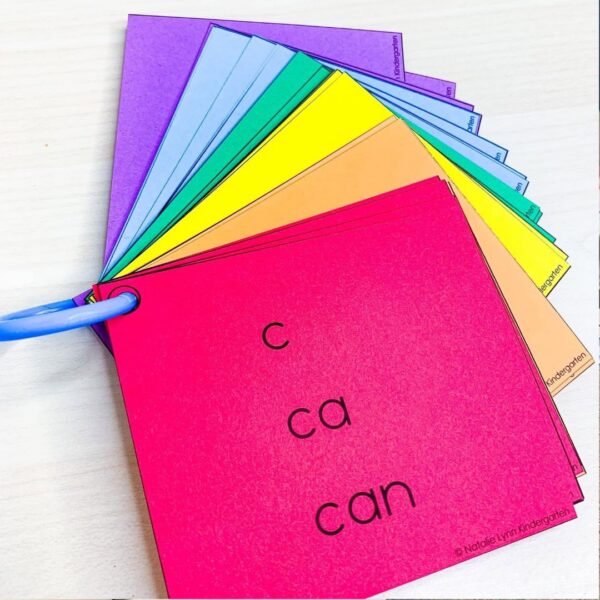
You can get free continuous blending cards sent to your inbox here:
Do you love free stuff?
Pyramid Blending Cards
These pyramid blending cards include options for continuous blending and sound by sound blending practice.
If your student is rushing and trying to guess…
Then go back to the word level.
If you have a student who knows their letter sounds, can blend orally, and can blend words in isolation BUT they still struggle with blending while reading because they rush and guess, it’s time to go back to the word level.
But not every word!
Instead, focus on look-alike words to help students realize that they need to look at ALL of the sounds of the words to make sure they get it right.
For example, mat and map are look-alike words. Map and mop are also look-alike words.
These are words that are easy to confuse as different words because their letters are so similar.
Some ways to work with look-alike words are:
- Show students two words. Say one word and have students identify which written word matches.
- Show students two pictures of similar words. Say the sounds of one word and have students identify which picture matches.
- Write two sentences, just changing one word in the sentence. Have students read both sentences and then identify which one is correct (The cat sat on the mat or The cap sat on the mat).
What NOT to Do When Kindergarten Students Can’t Blend Words
Now that we’ve talked about what to do when kindergarten students can’t blend words, let’s talk about what NOT to do.
These are strategies that have the best intentions, but can actually make the blending process more difficult.

Don’t just tell students to “sound it out”
Yes, sounding it out is what we want our students to do!
But if a student is struggling with blending sounds together, telling them to sound the word out isn’t actually teaching them what to do.
They might be able to say each letter sound, but they still can’t turn those sounds into a word.
Instead, explicitly model the blending process and then prompt students to try.
Note: If you know your student can blend but they’re just rushing and guessing, saying ”sound it out” is fine!
Don’t rely on CVC worksheets
CVC worksheets can be helpful for practicing skills you’ve taught.
But completing a worksheet is very different than explicit blending instruction.
Students can complete page after page, but it isn’t going to magically teach them the blending process or build those missing phonemic awareness skills.
Instead, make time for short, intentional practice with immediate teacher feedback.
Don‘t choose random CVC words
Once your students have gotten the hang of blending, working with any CVC words is fine.
But when we’re working with beginning readers, we want to be intentional about the words we choose.
Choose words with sounds students already know well.
This allows them to focus on blending instead of trying to remember letter sounds at the same time.
If you are using continuous blending, also pay attention to whether you are choosing continuous or stop sounds.
Don‘t encourage guessing strategies
I’ll admit, I’ve done it!
There once was a time when we thought cuing strategies like ”check the picture” were the standard.
But we want our students READING not guessing.
Picture and context clues can help give students a better understanding of what they’re reading, but they shouldn’t replace decoding.
If our goal is to have students look at the sounds of the words and decode, then our instruction and prompts should match.
Don’t immediately rescue students
When a student is struggling with blending, it‘s natural to want to jump in and help so they don’t get frustrated.
But the growth is in the struggle.
If we immediately tell them every word, we’re taking away their opportunity to practice and grow.
Instead, pause. Give students a moment to try.
If they’re stuck, of course we can still help! Provide a specific prompt or model working through the word.
The goal isn’t no support, but just enough to allow them to experience success.
Don‘t move too quickly
Finally, don’t feel like you need to rush your students from letters to sounds to CVC words and sentences.
I know it can feel like a race against time! Kindergarten teachers have immense pressure to get their students reading as quickly as possible.
But moving too quickly through foundational skills can actually make reading more difficult in the long run.
Sometimes the best thing we can do for our beginning readers is to slow down.
Should Students Who Can’t Blend Words Be Reading Decodable Books?
This is a question I think a lot of kindergarten teachers struggle with!
We know that decodable readers are an important part of science of reading-aligned instruction.
But what if our students aren’t ready to read traditional decodable books yet?
Here’s what I want you to know:
You do NOT have to jump straight into decodable readers with students who are still learning how to blend!
It’s okay to spend time working on oral blending, letter sound automaticity, and blending individual words first.
In fact, that may be exactly what your students need.
However, once students are beginning to blend words with support, we can start introducing simple decodable text.
The key is choosing decodable readers that actually match the skills students are learning.
For beginning blenders, I recommend looking for decodable readers that:
- Have only one or two words on each page.
- Use a small set of letter sounds students have already learned.
- Provide opportunities to practice the same phonics skills repeatedly.
- Allow students to experience success without becoming overwhelmed by too much text.
For example, if your students have only been working with the letters m, a, s, and t, we don’t want to hand them a decodable reader filled with unfamiliar letter sounds and complicated words!
We want the text to be an extension of what we’ve already been practicing during our small group lessons.
Bridging the Gap Between Letter Sounds and Decodable Readers
This is actually one of the reasons I created the Bridge Unit in my Science of Reading Guided Curriculum.
So many teachers were coming to me with the exact same struggle – I’ve taught all the letters, my students know them in isolation, but they’re struggling with the blending skill.
I wanted to help bridge that gap between students who are learning their letter sounds and students who are ready to begin reading decodable text.
Because sometimes our students aren’t quite ready for traditional CVC decodable readers, but they ARE ready to begin putting the sounds they know together!
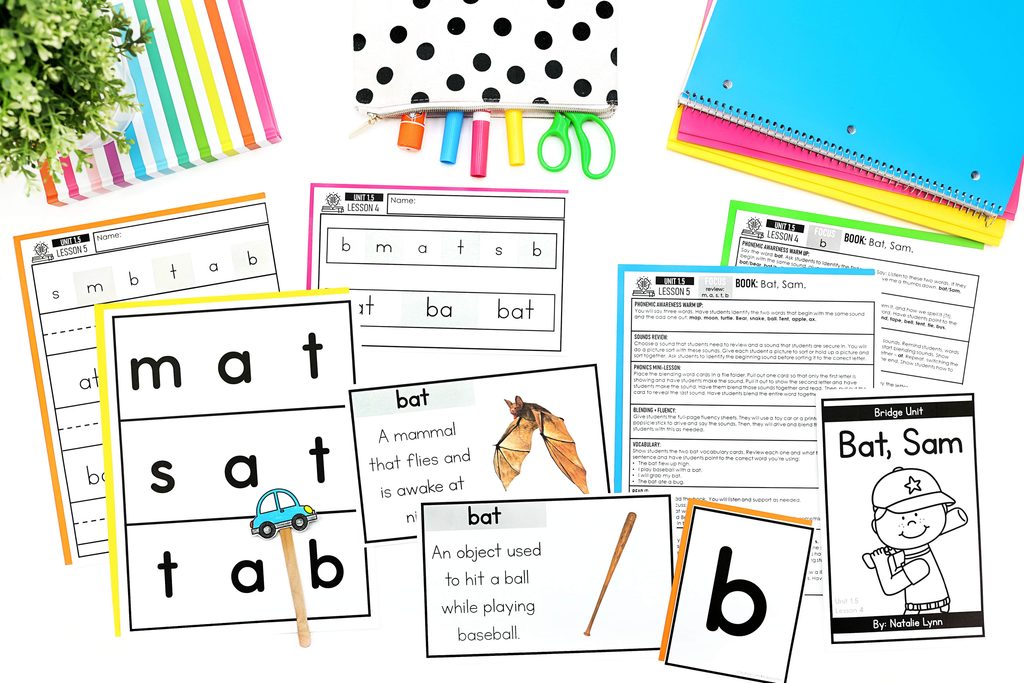
Rather than rushing students into reading longer texts, we can focus on building their confidence with blending and beginning decoding skills.
The goal is to help students experience success as readers while giving them the explicit instruction and practice they need.
Each lesson adds in just 1 letter. Seriously!
And the first few books only have 1-2 words per page.
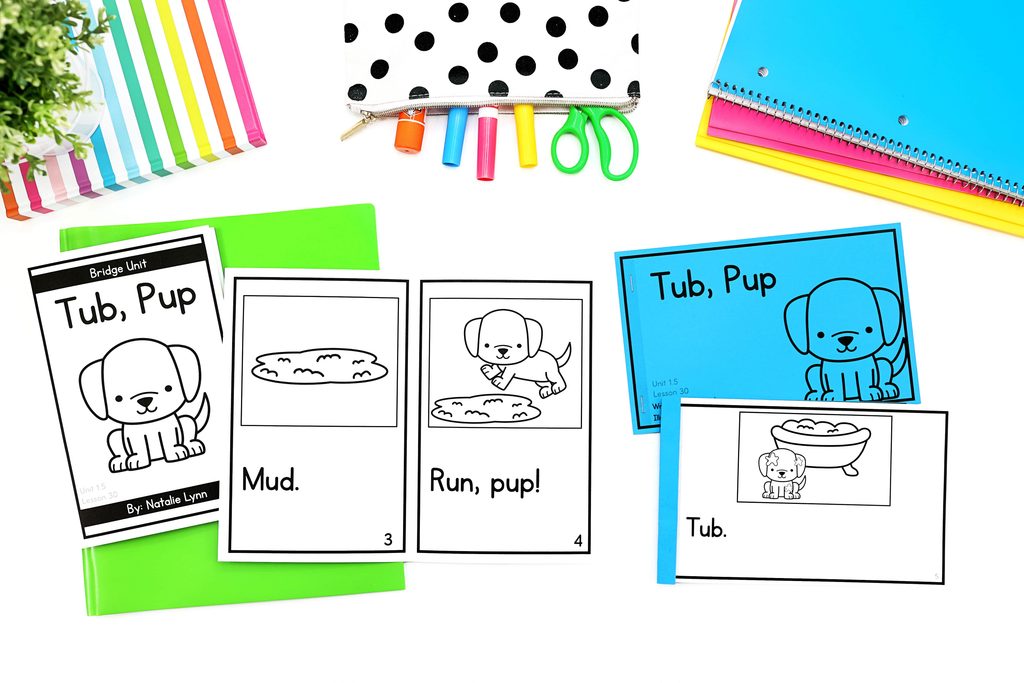
As the lessons go on, students will add more sounds and longer sentences, but the goal is to go slow now to build a strong foundation for later.
👉Check out the Bridge Unit here.
Blending takes practice
If your kindergarten students can’t blend words, the solution isn’t necessarily more practice.
Instead, we need to figure out exactly where the blending process is breaking down so that we can give them the RIGHT practice.
Are they struggling to blend sounds orally?
Are their letter sounds not automatic?
Are they rushing and trying to guess?
Once we know why students are struggling, we can provide targeted and explicit instruction that meets them where they are.
Need Help Teaching Beginning Blenders?
If you’re looking for a more structured way to teach blending in small groups, my Science of Reading Guided Curriculum was designed to help you provide explicit, systematic phonics instruction.
In particular, Bridge Unit 1.5 focuses on helping students make that important transition between learning letter sounds and beginning to read decodable text.
It’s a great place to focus when you have students who know some letter sounds but aren’t quite ready to jump into traditional CVC decodable readers.
Because sometimes our students don’t need us to move them forward faster.
They need us to give them the right support to take that next step!